
8. Sınıf İngilizce 1. Dönem 2. Ortak Yazılı – Senaryo 3
8. sınıf İngilizce 1. dönem 2. ortak yazılı Senaryo 3: Emre ile Nuri Bey’in dostluğu, aşure yapımı ve telefon görgü kuralları. Friendship, Teen Life, In the Kitchen, On the Phone ünitelerinden 6 açık uçlu soru, 100 puan.
Ekranda çöz
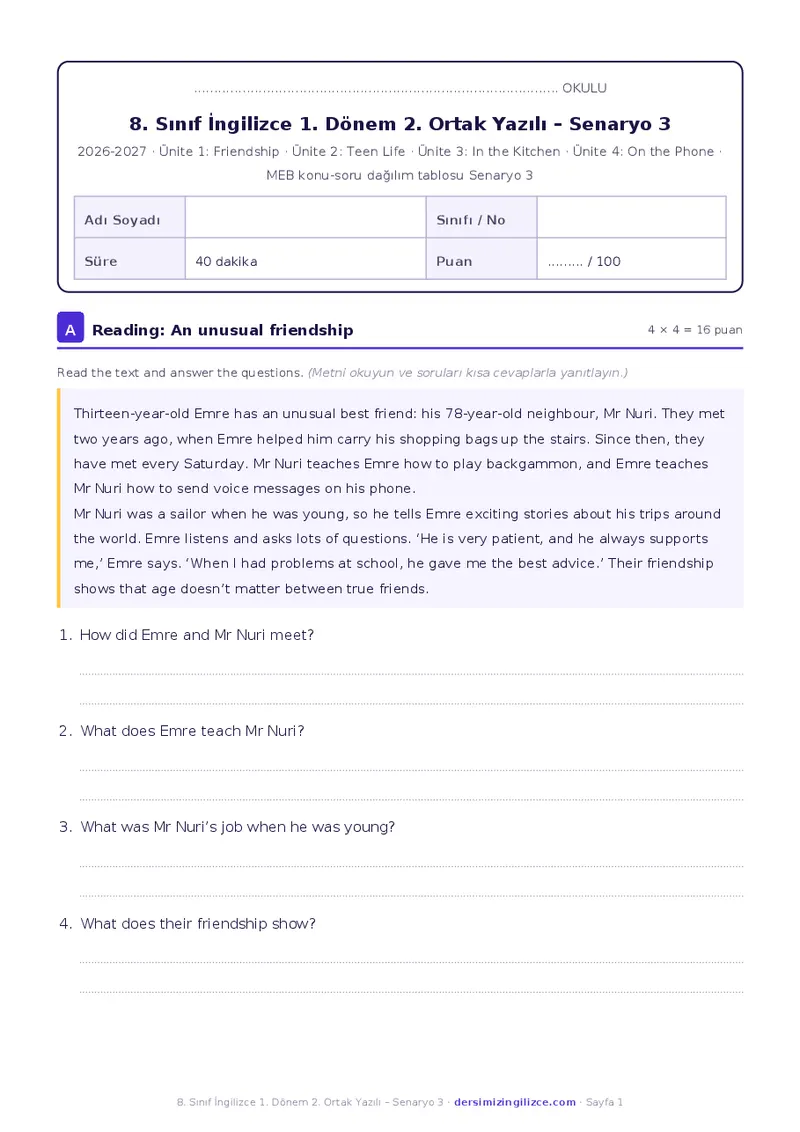
Reading: An unusual friendship
4 × 4 = 16 puanRead the text and answer the questions. (Metni okuyun ve soruları kısa cevaplarla yanıtlayın.)
- How did Emre and Mr Nuri meet?
- What does Emre teach Mr Nuri?
- What was Mr Nuri’s job when he was young?
- What does their friendship show?
Writing: Teens after school
1 × 16 = 16 puanWrite a short paragraph (50–70 words). (Kısa bir paragraf yazın (50–70 kelime).)
- Write a paragraph for your school blog: What do the teenagers in your class usually do after school? What do they like and dislike?
Reading: Aşure day
5 × 4 = 20 puanRead the text and answer the questions. (Metni okuyun ve soruları kısa cevaplarla yanıtlayın.)
- Why do they start the night before?
- What do they soak in water?
- How long do they boil the wheat?
- Why do they stir the mixture again and again?
- What do they decorate the bowls with?
Writing: Cooking pasta
1 × 16 = 16 puanPut the notes in order and describe the process in 5–6 sentences. Use linkers. (Notları sıraya koyun ve süreci bağlaçlar kullanarak 5–6 cümleyle anlatın.)
- Notes (not in order): drain the water · boil water with a little salt · add tomato sauce and grated cheese · put the pasta in · cook for about ten minutes and stir.
Reading: Phone manners
4 × 4 = 16 puanRead the text and answer the questions. (Metni okuyun ve soruları kısa cevaplarla yanıtlayın.)
- Who wrote these tips?
- What should you do first when someone picks up?
- What should you leave if the person isn’t available?
- What should you do if the line is bad?
Writing: Booking tickets
1 × 16 = 16 puanWrite a short phone conversation (6–8 lines). (Kısa bir telefon konuşması yazın (6–8 satır).)
- You call Galaxy Cinema to book three tickets for the 7 o’clock film on Saturday. Write the conversation between you and the cinema assistant.
Bu sınav hakkında
MEB tablosundaki Senaryo 3’e göre 8. sınıf İngilizce 1. dönem 2. yazılı: Emre ile yaşlı komşusunun dostluğu, gençlerin okul sonrası, aşure yapımı, makarna tarifi, telefon görgü kuralları ve sinema bileti telefonu. 6 açık uçlu soru, 3’ü yazma.
Senaryo 3 yazma ağırlıklı bir senaryodur: tablodaki altı sorunun üçü yazmadır (E8.2.W1, E8.3.W1, E8.4.W1); diğerleri E8.1.R1, E8.3.R1 ve E8.4.R1 okuma sorularıdır. Okuma metinleri 13 yaşındaki Emre ile 78 yaşındaki eski denizci komşusu Nuri Bey’in dostluğu, bir ailenin her yıl komşularıyla paylaştığı aşurenin yapılışı ve okulun iletişim kulübünün telefon görgü kuralları üzerine.
Yazma görevlerinde sınıfınızdaki gençlerin okul sonrası etkinliklerini anlatan bir blog paragrafı, karışık verilen notları sıraya koyarak makarna tarifi ve sinemadan bilet ayırtma konuşması yazarsınız. Aşure metninde beş, diğer okumalarda dört kısa cevaplı soru var; toplam 100 puan. Tarif yazarken bağlaçları (First, Then, Next, After that, Finally) mutlaka kullanın; telefon konuşmasında karşı tarafın kim olduğunu ilk satırda belirtin. Kâğıdı PDF olarak yazdırıp çözebilir ya da online çözümde cevaplarınızı hemen kontrol edebilirsiniz.
İçindekiler
| Bölüm | Başlık | Soru türü | Madde | Puan | Öğrenme çıktısı |
|---|---|---|---|---|---|
| A | Reading: An unusual friendship · okuma metni | Açık uçlu / yazma | 4 | 16 | E8.1.R1 |
| B | Writing: Teens after school | Açık uçlu / yazma | 1 | 16 | E8.2.W1 |
| C | Reading: Aşure day · okuma metni | Açık uçlu / yazma | 5 | 20 | E8.3.R1 |
| D | Writing: Cooking pasta | Açık uçlu / yazma | 1 | 16 | E8.3.W1 |
| E | Reading: Phone manners · okuma metni | Açık uçlu / yazma | 4 | 16 | E8.4.R1 |
| F | Writing: Booking tickets | Açık uçlu / yazma | 1 | 16 | E8.4.W1 |
MEB konu-soru dağılımı (Senaryo 3)
Bu kâğıt, MEB'in ortak yazılı sınavlar için yayımladığı konu-soru dağılım tablosundaki Senaryo 3 dağılımına göre hazırlandı.
Sık sorulan sorular
8. sınıf İngilizce 1. dönem 2. yazılı hangi konulardan?
Tabloya göre 1. dönem 2. ortak yazılı dönemin tamamından soru içerir; ağırlık In the Kitchen (E8.3.R1, E8.3.R2, E8.3.W1) ve On the Phone (E8.4.R1, E8.4.W1) ünitelerindedir. Bazı senaryolarda Friendship, Teen Life ve The Internet kazanımları da yer alır. Senaryo 3’te şu kazanımlar var: E8.1.R1 (1 soru), E8.2.W1 (1 soru), E8.3.R1 (1 soru), E8.3.W1 (1 soru), E8.4.R1 (1 soru), E8.4.W1 (1 soru).
8. sınıf İngilizce 1. dönem 2. yazılı Senaryo 3’te kaç soru var?
Bu kâğıtta 6 soru var; her soru bir kazanımı ölçen ayrı bir bölümdür ve toplam 16 maddeden oluşur. Toplam puan 100, süre 40 dakikadır. Soru sayısı ve kazanımlar MEB tablosundaki Senaryo 3 ile birebir aynıdır.
Bu yazılı kâğıdının cevap anahtarı var mı?
Var. Kâğıdın PDF’i ücretsiz indirilir ve online çözümde cevaplarınız anında kontrol edilir; açık uçlu sorular için örnek cevapları içeren cevap anahtarı PDF’i ise Pro öğretmen üyelere açıktır (ücretsiz deneme ile denenebilir).
Bu yazılı kâğıdı LGS hazırlığına da yardımcı olur mu?
Evet, kelime ve kalıplar aynı olduğu için yardımcı olur; ancak biçim farklıdır. LGS çoktan seçmeli bir testtir, ortak yazılı ise açık uçludur. LGS için ayrıca test çözmeniz gerekir.
Bu senaryoda neden üç yazma sorusu var?
MEB tablosunda 1. dönem 2. yazılı Senaryo 3, E8.2.W1, E8.3.W1 ve E8.4.W1 kazanımlarından birer soru ister. Bu yüzden kâğıtta üç kısa yazma görevi ve üç okuma sorusu bulunur.