
7. Sınıf İngilizce 2. Dönem 2. Ortak Yazılı – Senaryo 2
7. sınıf İngilizce 2. dönem 2. ortak yazılı Senaryo 2: Japonya’da Çocuk Bayramı, Muğla’da fidan dikimi, fidan dikme süreci, Jüpiter ile Satürn ve Venüs bilgi kartı.
Ekranda çöz
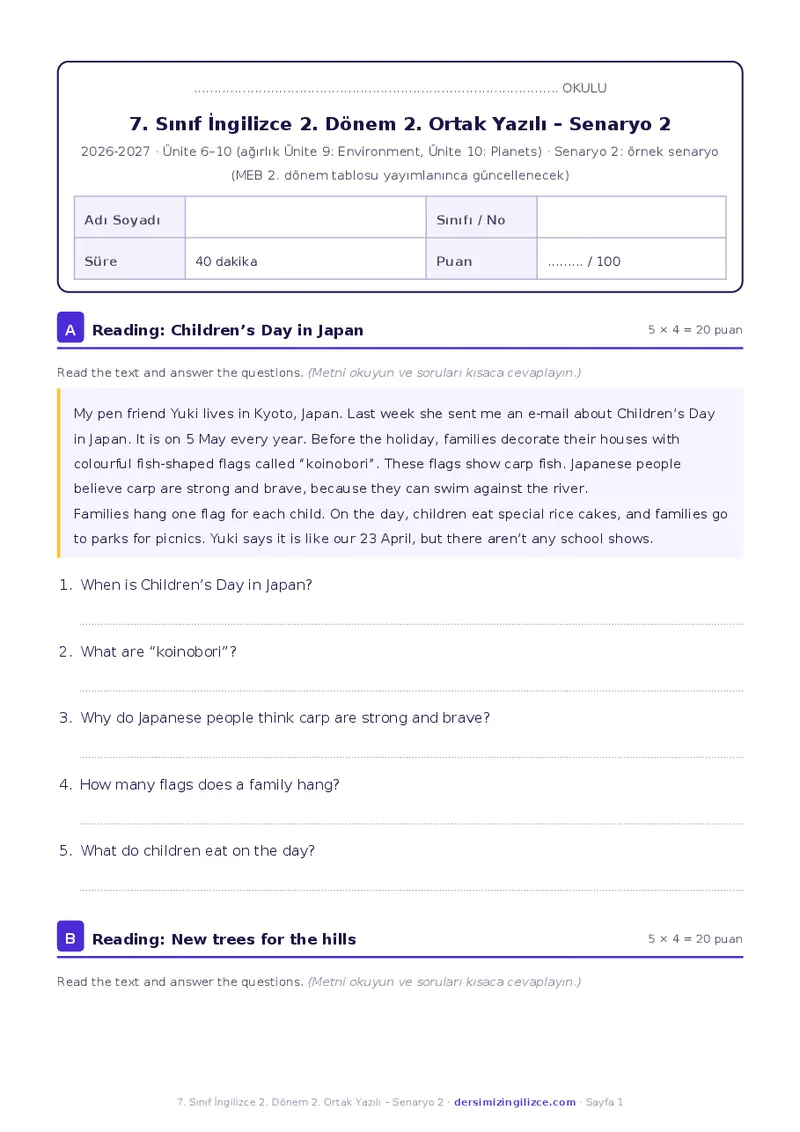
Reading: Children’s Day in Japan
5 × 4 = 20 puanRead the text and answer the questions. (Metni okuyun ve soruları kısaca cevaplayın.)
- When is Children’s Day in Japan?
- What are “koinobori”?
- Why do Japanese people think carp are strong and brave?
- How many flags does a family hang?
- What do children eat on the day?
Reading: New trees for the hills
5 × 4 = 20 puanRead the text and answer the questions. (Metni okuyun ve soruları kısaca cevaplayın.)
- What happened near the village two summers ago?
- How many volunteers came to the village?
- Which trees did they plant?
- Write one reason why forests are important.
- Write one thing people mustn’t do in forests.
Writing: How to plant a tree
1 × 20 = 20 puanRead the notes and describe the process. (Notları okuyun ve süreci anlatın.)
- Look at the notes. Describe how to plant a sapling. Use First, Then, Next, After that and Finally. (5–6 sentences)
Reading: Two giants
5 × 4 = 20 puanRead the text and answer the questions. (Metni okuyun ve soruları kısaca cevaplayın.)
- Why don’t Jupiter and Saturn have a hard surface?
- How much wider than Earth is Jupiter?
- What is the Great Red Spot?
- What are Saturn’s rings made of?
- Which moon has a thick atmosphere?
Writing: A fact file about Venus
1 × 20 = 20 puanRead the notes and write a short description. (Notları okuyun ve kısa bir tanım yazın.)
- Use the notes and write a short description of Venus. Use the present simple and at least one comparison. (5–6 sentences)
Bu sınav hakkında
7. sınıf İngilizce 2. dönem 2. ortak yazılı için 5 soruluk örnek senaryo. Celebrations (E7.6.R1), Environment (E7.9.R1, E7.9.W2) ve Planets (E7.10.R1, E7.10.W1) kazanımlarını ölçer; okuma soruları kısa cevaplı, yazma soruları süreç anlatımı ve bilgi metnidir.
Senaryo 2’de Kyoto’da yaşayan mektup arkadaşı Yuki’nin anlattığı Japon Çocuk Bayramı ve sazan balığı biçimli “koinobori” bayrakları okunur. Environment bölümünde Muğla’da yanan bir ormana Millî Ağaçlandırma Günü’nde fidan diken gönüllülerin haberi yer alır; öğrenci ardından bir fidanın nasıl dikileceğini First, Then, Next, Finally ile anlatır. Planets bölümünde iki gaz devi Jüpiter ve Satürn karşılaştırılır; son soruda öğrenci verilen notlarla Venüs için kısa bir bilgi metni yazar.
Kâğıtta 5 soru ve toplam 17 madde var: 1) Reading: Children’s Day in Japan – okuma metnine kısa cevap (E7.6.R1, 5 × 4 puan); 2) Reading: New trees for the hills – okuma metnine kısa cevap (E7.9.R1, 5 × 4 puan); 3) Writing: How to plant a tree – paragraf yazma (E7.9.W2, 20 puan); 4) Reading: Two giants – okuma metnine kısa cevap (E7.10.R1, 5 × 4 puan); 5) Writing: A fact file about Venus – paragraf yazma (E7.10.W1, 20 puan). Ortak yazılı kuralına uygun olarak tüm sorular açık uçlu ve kısa cevaplıdır; çoktan seçmeli, eşleştirme ya da doğru-yanlış sorusu yoktur.
Okuma sorularında cevabı metinde bulup kısa ve net yazın; tam cümle şart değildir ama bilgi eksiksiz olmalıdır. Paragraf sorularında önce birkaç anahtar kelime not alın, sonra cümleleri First, Then, Finally gibi bağlaçlarla sıralayın.
İçindekiler
| Bölüm | Başlık | Soru türü | Madde | Puan | Öğrenme çıktısı |
|---|---|---|---|---|---|
| A | Reading: Children’s Day in Japan · okuma metni | Açık uçlu / yazma | 5 | 20 | E7.6.R1 |
| B | Reading: New trees for the hills · okuma metni | Açık uçlu / yazma | 5 | 20 | E7.9.R1 |
| C | Writing: How to plant a tree · okuma metni | Açık uçlu / yazma | 1 | 20 | E7.9.W2 |
| D | Reading: Two giants · okuma metni | Açık uçlu / yazma | 5 | 20 | E7.10.R1 |
| E | Writing: A fact file about Venus · okuma metni | Açık uçlu / yazma | 1 | 20 | E7.10.W1 |
MEB konu-soru dağılımı (Senaryo 2)
Bu kâğıt, MEB'in ortak yazılı sınavlar için yayımladığı konu-soru dağılım tablosundaki Senaryo 2 dağılımına göre hazırlandı.
Sık sorulan sorular
7. sınıf İngilizce 2. dönem 2. yazılı hangi konulardan?
2. dönem 2. yazılı, 2. dönemin tamamını (Celebrations, Dreams, Public Buildings, Environment, Planets) kapsar; soruların çoğu son iki üniteden, Environment ve Planets’ten gelir. Senaryo 2’de sorular Celebrations, Environment, Planets ünitelerinden gelir.
Senaryo 2’de kaç soru var?
Senaryo 2’de 5 soru (toplam 17 madde) bulunur. Puanların toplamı 100, süre 40 dakikadır; her soru bir öğrenme çıktısını ölçer.
Bu kâğıt hangi kazanımları ölçüyor?
E7.6.R1: kutlamalarla ilgili metinleri anlama (1 soru); E7.9.R1: çevreyle ilgili metinlerde belirli bilgiyi bulma (1 soru); E7.9.W2: bir süreci kısaca yazılı olarak anlatma (1 soru); E7.10.R1: gerçekler ve genel doğrularla ilgili metinlerde belirli bilgiyi bulma (1 soru); E7.10.W1: gerçekler ve genel doğrularla ilgili kısa tanımlar yazma (1 soru).
Cevap anahtarı var mı?
Cevap anahtarı PDF’i Pro öğretmen üyeliğiyle indirilebilir, ücretsiz deneme süresi de vardır. Sınav PDF’i herkes için ücretsizdir; online çözümde öğrenciler cevaplarını hemen görebilir.
MEB 2. dönem konu-soru dağılım tablosu yayımlandı mı?
Henüz yayımlanmadı. Bu kâğıt, yıllık plandaki ünite sırasına ve 1. dönem tablosunun kalıbına göre hazırlanmış örnek bir senaryodur; MEB tabloyu yayımlayınca senaryo güncellenecektir.
Süreç anlatımı (E7.9.W2) nasıl yazılır?
Adımları sıralama kelimeleriyle (First, Then, Next, After that, Finally) ve emir kipiyle yazın: First, dig a hole. Then, put the sapling in it.